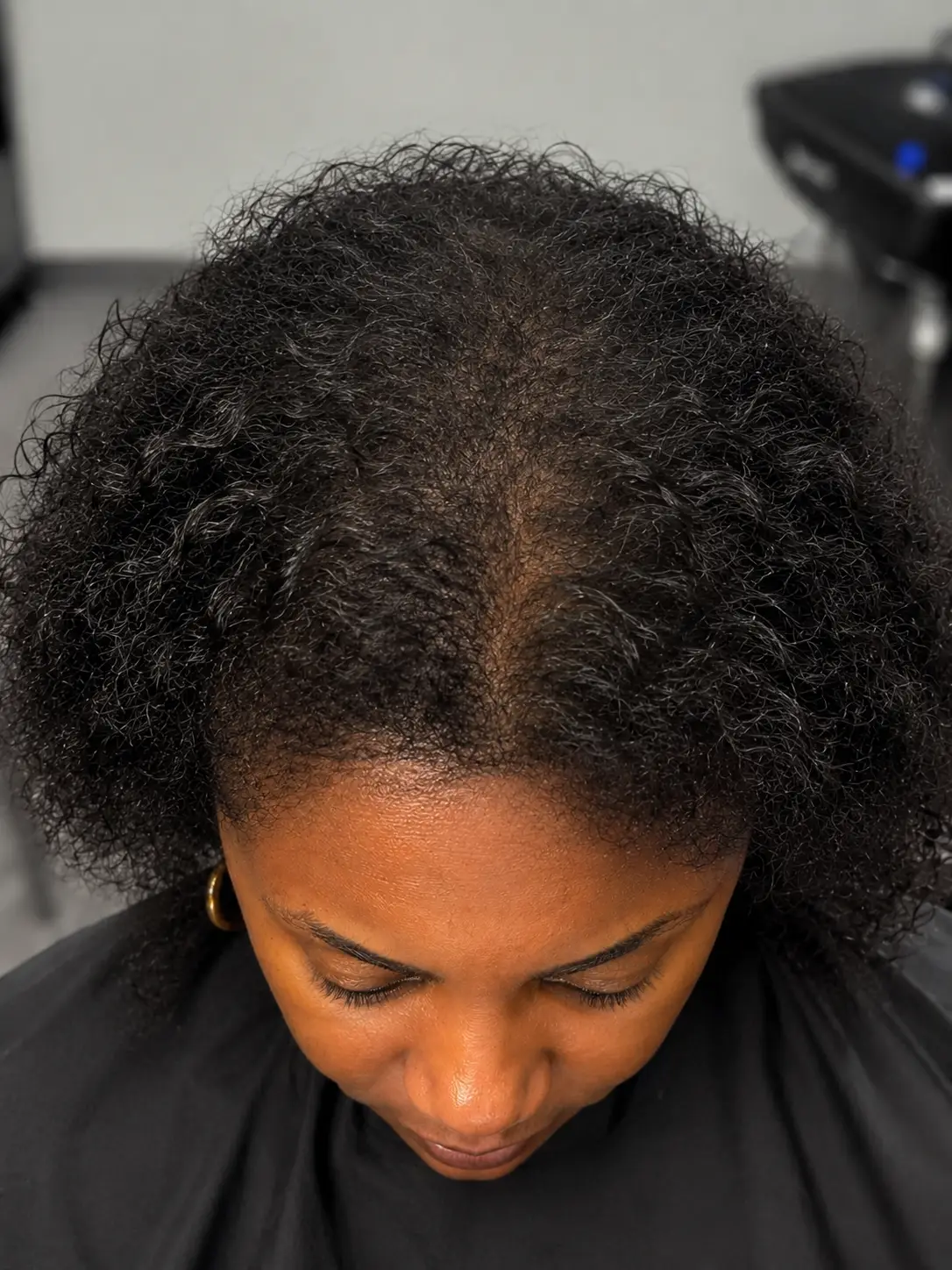

Why this matters for Black women
Published estimates put the lifetime rate of some form of scarring alopecia in Black women as high as 17 percent. CCCA alone is the leading cause of permanent hair loss in women of African descent.
Most hair loss content online is written for a general audience that does not reflect that reality. This post covers the specific scarring alopecias that affect Black hair, the warning signs, and why trichoscopy changes the diagnosis.
CCCA, the most common scarring alopecia in Black women
Central centrifugal cicatricial alopecia begins at the crown and spreads outward in a circle. The scalp often feels tender or itchy long before thinning is obvious. Research has linked a subset of cases to variants in the PADI3 gene, which affects how the hair shaft is formed.
CCCA is an inflammatory condition with a genetic basis. It gets mistaken for relaxer damage or ordinary thinning for years while follicles scar over. Read our CCCA page and the full CCCA article.
Traction alopecia that becomes scarring
Traction alopecia is the most preventable form of hair loss. Tension from braids, weaves, wigs, and locs pulls on follicles day after day. Early on the damage is reversible.
After years of sustained tension, the follicles at the edges, temples, and nape scar over and the loss becomes permanent. Our traction alopecia page covers the transition point and how to catch it.
Lichen planopilaris and frontal fibrosing alopecia
Lichen planopilaris produces patchy loss with perifollicular scaling and can look different on darker skin, where the violaceous border is harder to see. Frontal fibrosing alopecia is discussed most often in postmenopausal white women, and it occurs across all ethnicities. Both are covered in detail on our lichen planopilaris page.
Warning signs you should not ignore
Thinning at the crown that products do nothing for. Scalp tenderness, burning, or itching in specific spots. Smooth, shiny patches where hair used to be. Breakage that worsens despite protective styling. A widening part with no family history of pattern baldness.
Why trichoscopy changes everything
A 200x scan shows what the naked eye cannot. Peripilar grey-white halos flag CCCA. Absent follicular openings mean scarring. Perifollicular scaling suggests lichen planopilaris. Miniaturization is an early warning.
Trichoscopy sorts follicles into three groups: viable, at risk, and already scarred. That map drives the entire plan. See scarring alopecia for how each sub-type is treated.
Treatment at Atlanta Trichology
Our team sees scarring alopecia every week. Dr. Nina Ross, the practitioner and architect of the practice, designs protocols combining PRP, exosomes, laser therapy, and anti-inflammatory care. A certified trichologist performs the trichoscopy and monitors progress at every visit.
The objective is halting the inflammatory front and saving every recoverable follicle. Staging matters here, so read CCCA alopecia stages to understand where you may be.
What is scarring alopecia in Black hair?
Scarring alopecia in Black hair refers to a group of inflammatory conditions that permanently destroy follicles and replace them with scar tissue, most commonly central centrifugal cicatricial alopecia, long-standing traction alopecia, and lichen planopilaris. CCCA is the leading cause of permanent hair loss in women of African descent, beginning at the crown and spreading outward, often with tenderness or itching before visible thinning. Traction alopecia becomes scarring when years of tension styling exhaust the follicles at the hairline and nape. Early detection is decisive because scarred follicles cannot be restored, while inflamed follicles at the active border frequently recover once inflammation is suppressed. Trichoscopy at 200x magnification identifies peripilar grey-white halos, absent follicular openings, and perifollicular scaling, which distinguishes the sub-types and maps viable follicles. Clinical literature in the Journal of the American Academy of Dermatology supports early anti-inflammatory and regenerative treatment for slowing progression and preserving density.
Get scanned
Book a $99 trichoscopy evaluation with a certified trichologist. 45 minutes. Call (678) 561-4522. We are at 8735 Dunwoody Place, Suite 290-O, Sandy Springs, GA 30350.