
The quiet crisis
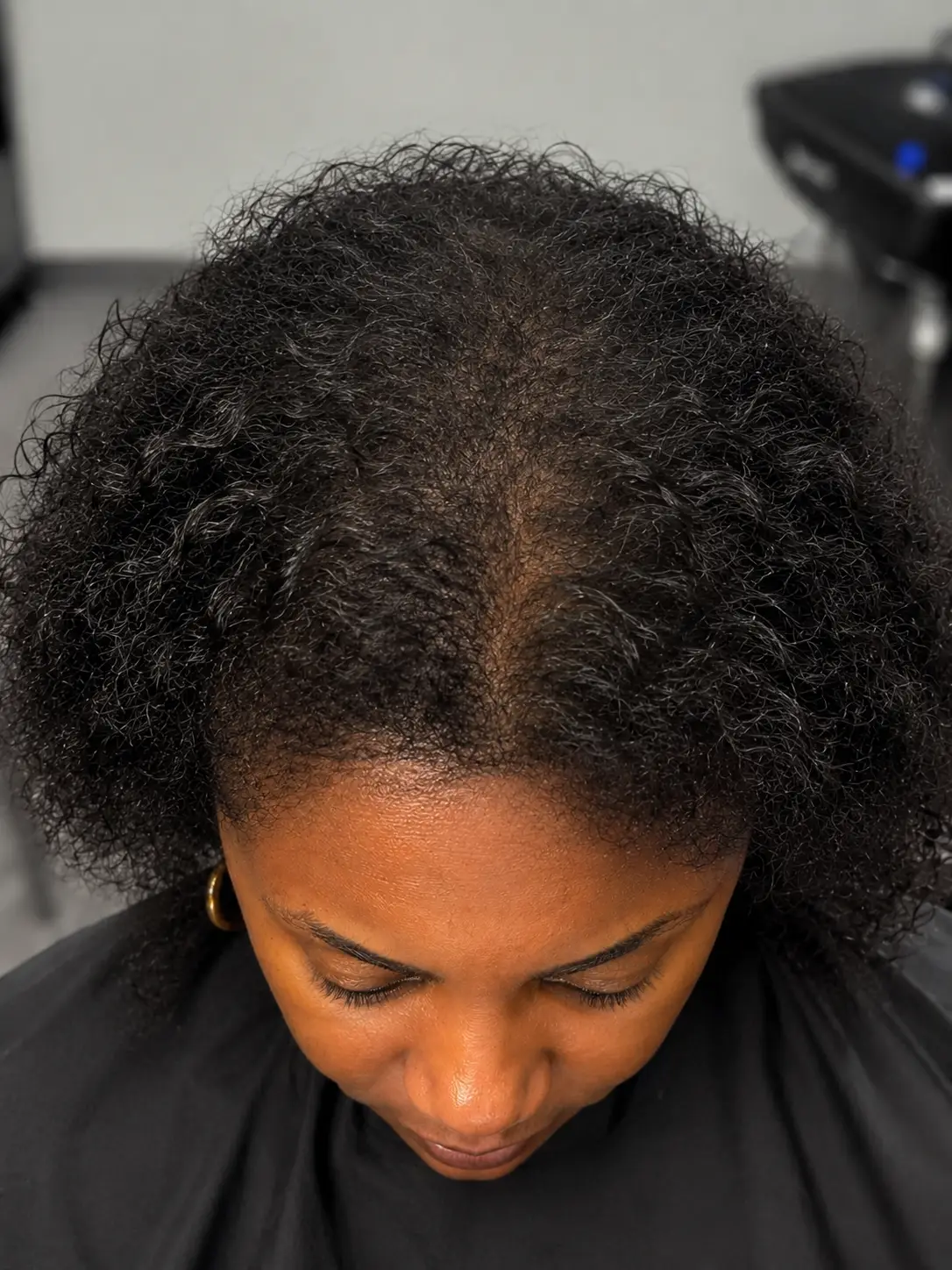
Up to 17 percent of Black women will develop some form of scarring alopecia, and CCCA is the most common type. It starts at the crown and spreads outward, destroying follicles permanently. The hardest part? In the early stages, it looks like regular thinning. Many women spend years trying products and protective styles before anyone tells them what is actually happening.
What CCCA actually is
Central centrifugal cicatricial alopecia is an inflammatory condition with a genetic component. A variant in the PADI3 gene increases the risk. The inflammation targets follicles at the crown, scarring them from the inside out. Once a follicle scars, it cannot grow hair again. This is not caused by relaxers or styling alone, though those can make it worse.
The signs to watch for
Gradual thinning at the crown that does not respond to any product. A widening part line. Tenderness, itching, or a burning sensation at the top of the scalp. Smooth, shiny patches where hair used to be. If your crown is thinning and nothing you have tried is helping, CCCA should be on the list of possibilities. See our CCCA condition page for the full clinical picture.
Why early detection changes everything
In the early stages, the inflammation is active but the follicles have not scarred yet. This is the window. Treatment during this stage can stop the progression and save your hair. Once scarring sets in, those follicles are gone for good. That is why trichoscopy matters so much. It spots the early markers, peripilar grey-white halos around follicles, long before the damage becomes visible.
How we treat CCCA at Atlanta Trichology
Our approach targets the inflammation from multiple angles. Dr. Nina Ross designs each protocol personally. Treatments include PRP injections to deliver growth factors directly to the follicle, exosome therapy for cellular repair, low-level laser therapy to reduce inflammation, and customized anti-inflammatory scalp treatments. Our certified trichologists monitor your progress with serial trichoscopy imaging at every visit. The treatment plan adjusts in real time based on how your scalp responds.
Your next step
If you have been dealing with crown thinning that does not seem to get better, stop guessing. A $99 trichoscopy evaluation gives you a clear answer in 45 minutes. Our certified trichologist will image your scalp at 200x, identify whether CCCA is present, and map out a treatment plan. Call (678) 561-4522. We are at 8735 Dunwoody Place, Suite 290-O, Sandy Springs, GA 30350.
What is CCCA and can it be treated?
CCCA (central centrifugal cicatricial alopecia) is the most common cause of permanent hair loss in women of African descent. The condition causes chronic inflammation at the crown of the scalp that destroys hair follicles from the inside out. A PADI3 gene variant increases susceptibility. Early symptoms include gradual crown thinning, scalp tenderness, and itching. Trichoscopy at 200x magnification reveals the diagnostic hallmark: peripilar grey-white halos surrounding affected follicles. These markers appear before visible hair loss, making early detection possible. Treatment focuses on halting the inflammatory process through PRP injections, exosome therapy, low-level laser therapy, and anti-inflammatory scalp treatments. At Atlanta Trichology, Dr. Nina Ross, our in-house practitioner, designs each treatment protocol while certified trichologists perform evaluations and monitor progress with serial imaging. The $99 trichoscopy evaluation identifies whether CCCA is present and determines the stage. Early treatment preserves follicles that later-stage intervention cannot save.