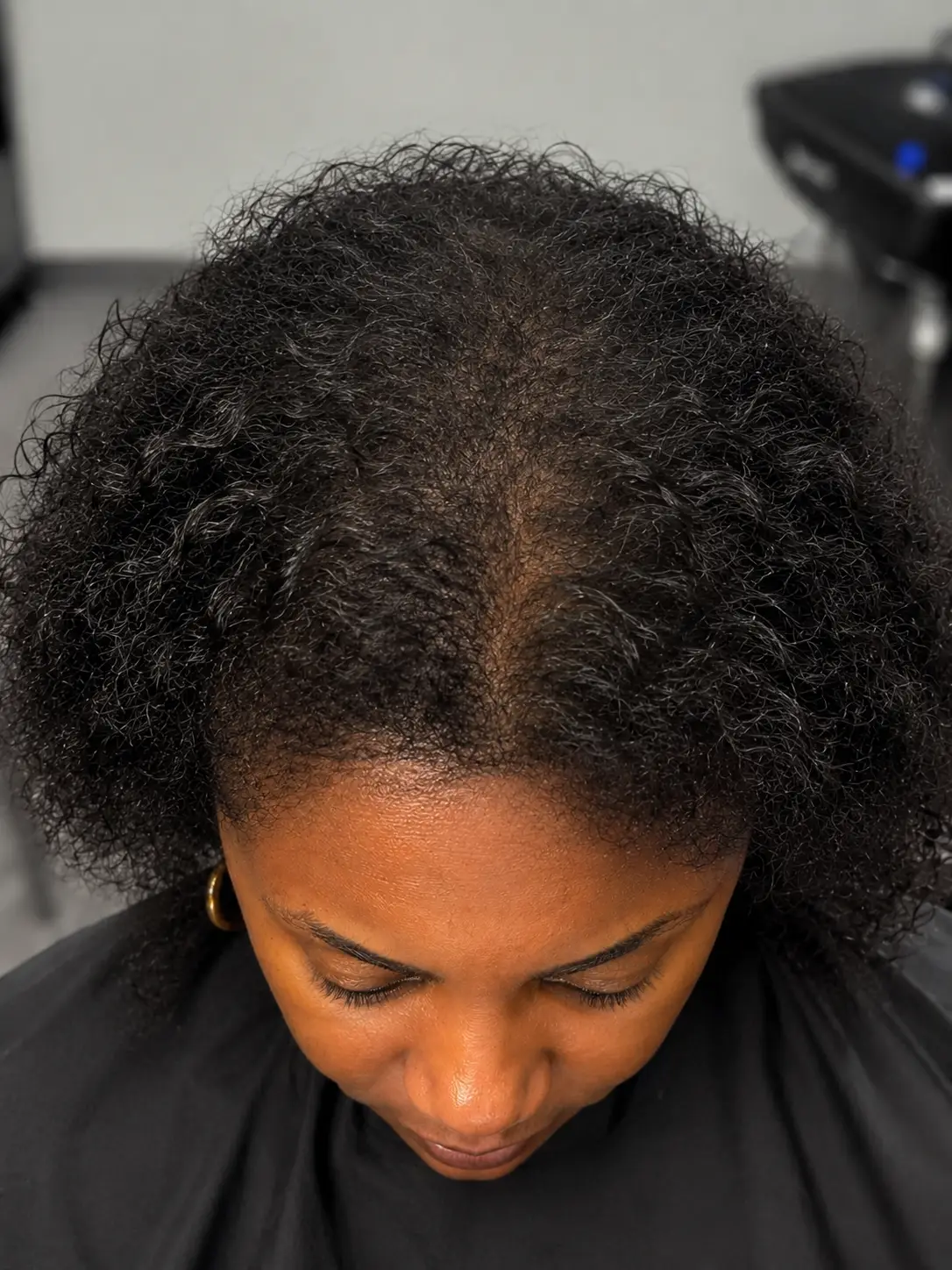

The scalp is a diagnostic surface
Your scalp is the soil your hair grows in, and it reports on conditions long before hair loss becomes visible. Every symptom means something. Itch, tenderness, oiliness, flaking, and redness each point toward a different set of causes. Learning to read them buys you months, sometimes years, of intervention time.
Persistent itch
Itching that will not resolve is an inflammatory signal. The most common driver is fungal overgrowth, usually Malassezia yeast, which feeds on scalp sebum and produces irritating byproducts. Second is contact dermatitis from product ingredients, commonly sulfates, fragrance, or preservatives. Third is early folliculitis, where individual follicles become infected and inflamed.
Itch paired with flaking points toward microbiome imbalance, typically seborrheic dermatitis. Itch paired with small pustules or bumps points toward folliculitis. Itch with no visible change at all is the one people ignore longest, and it is often the earliest signal of a follicular inflammatory process.
Tenderness and pain
Scalp pain is never normal. A tender crown, particularly one that hurts when hair is pulled back or when you press on it, is a classic early presentation of central centrifugal cicatricial alopecia. Tenderness along the hairline and temples usually indicates traction alopecia from sustained styling tension.
Tenderness with visible bumps suggests folliculitis or, in more severe presentations, folliculitis decalvans. Burning or stinging without any visible sign, sometimes called trichodynia, still warrants trichoscopy, because inflammation at the follicular level is often present under magnification while the surface looks unremarkable.
Excessive oiliness
Sudden oiliness that was not there before is usually hormonal. Androgens stimulate sebaceous glands directly. When elevated oil production appears alongside shedding or a widening part, the picture commonly points toward androgenetic alopecia or an underlying hormonal shift from PCOS, perimenopause, or thyroid dysfunction.
Excess sebum also creates a secondary problem. It feeds Malassezia and can plug follicular openings, which we see clearly under trichoscopy as yellow dots. That plugging compounds whatever hormonal thinning is already underway.
Flaking and scaling
Not all flakes are the same, and the difference determines treatment. Fine white flakes with mild itch and an oily scalp indicate dandruff, which is mild seborrheic dermatitis. Thick, silvery, well-demarcated plaques that extend past the hairline and may bleed slightly when lifted indicate psoriasis, an autoimmune process requiring a different protocol entirely.
Small dry flakes on a scalp that feels tight, with no redness, usually indicate genuine dryness from over-washing or harsh products. Yellow greasy scale is seborrheic dermatitis in a more active phase. Getting this distinction right matters, because treating scalp psoriasis like dandruff wastes months.
Redness and visible inflammation
A healthy scalp is a consistent pale pink to warm brown depending on your skin tone, with no visible vascular activity. Diffuse redness signals active inflammation. Red rings around individual follicles, which we call perifollicular erythema, indicate the follicular unit itself is under attack. Spreading redness with warmth suggests infection and needs prompt clinical attention.
In deeper skin tones scalp redness can be subtle and easy to miss with the naked eye. Under 200x magnification it is obvious. This is one of the clearest arguments for imaging rather than visual inspection alone.
What trichoscopy reveals
A 200x trichoscopy scan shows what no naked-eye exam can. We measure follicular miniaturization by comparing shaft diameters across the scalp, because variability above roughly 20 percent is a hallmark of androgenetic patterns. We count follicular units and identify empty ostia. We assess perifollicular erythema and scaling to grade inflammation. We look at vascular patterns, since arborizing vessels and looped capillaries carry diagnostic meaning. We identify yellow dots from sebum plugging, black dots from broken shafts, and exclamation mark hairs, which are specific to alopecia areata.
All of it is photographed and mapped so your next scan is measured against a real baseline rather than memory.
Decode the message
Your scalp is trying to tell you something. A 45-minute comprehensive scalp evaluation with 200x trichoscopy, performed by a certified trichologist, decodes it for $99. Call (678) 561-4522 or book online. 8735 Dunwoody Place, Suite 290-O, Sandy Springs, GA 30350.