The evidence gap
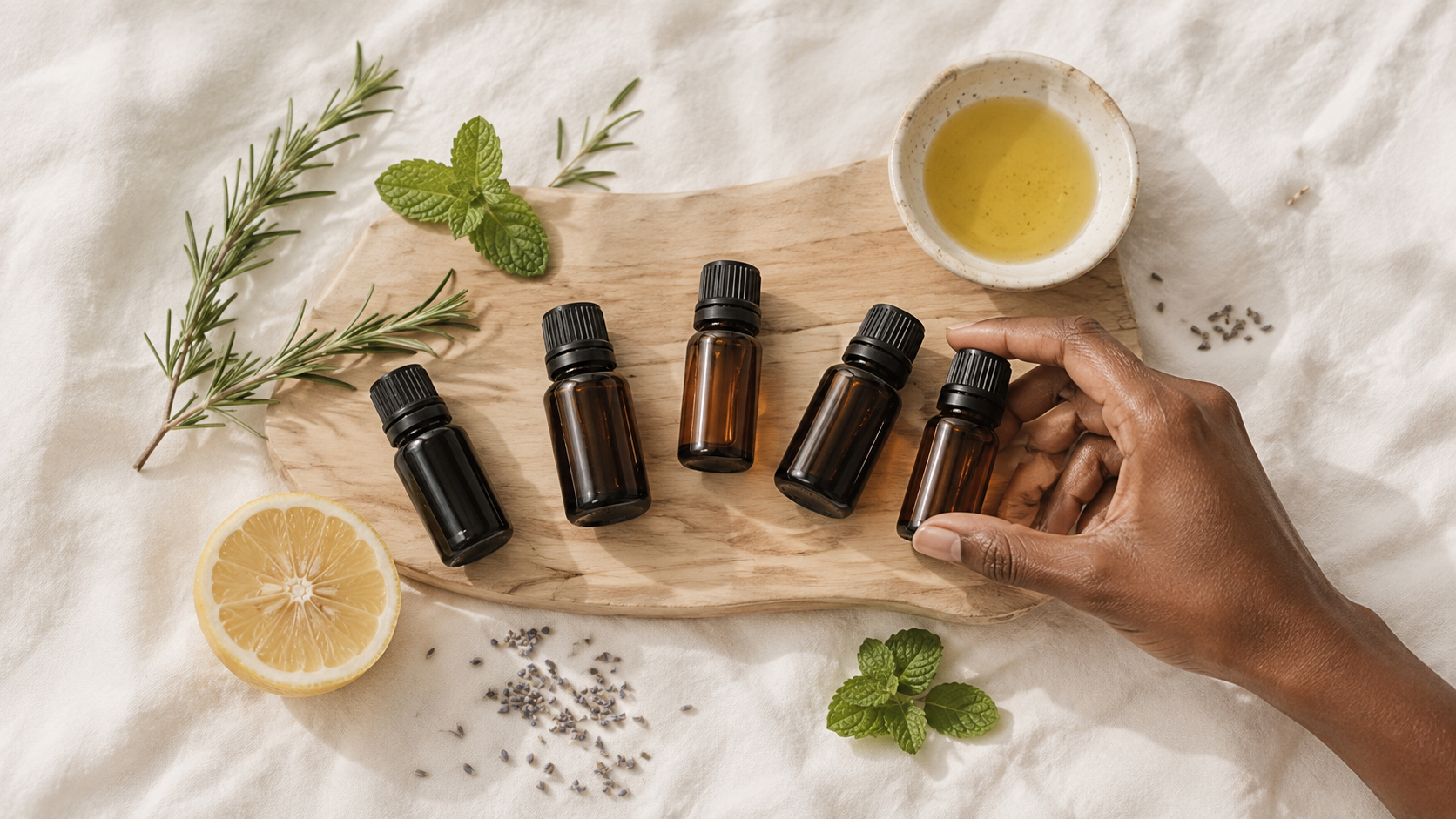
Search for hair oils and you will find thousands of confident claims backed by nothing. The honest picture is narrower. A small group of essential oils has real clinical or preclinical support, and even those work best as one component of a broader protocol. After sixteen years of clinical trichology practice, these are the six we keep in rotation and the reasons why.
1. Rosemary oil
Rosemary is the most studied of the group. A 2015 randomized comparative trial published in SKINmed compared rosemary oil against 2 percent minoxidil in androgenetic alopecia patients over six months and found comparable hair count increases in both groups, with significantly less scalp itching in the rosemary arm. The proposed mechanisms are improved microcirculation at the follicle and inhibition of dihydrotestosterone activity at the receptor level.
2. Peppermint oil
Menthol is a vasodilator. It increases local blood flow, which is why peppermint produces that cooling tingle. A 2014 study in Toxicological Research applied 3 percent peppermint oil to mice over four weeks and reported significant increases in follicle number, follicle depth, and dermal thickness compared with saline, jojoba, and minoxidil controls. Human data is still thin, but the mechanism is plausible and the safety profile at low dilution is excellent.
3. Tea tree oil
Tea tree earns its place through antimicrobial and anti-inflammatory activity rather than direct growth stimulation. It is effective against Malassezia, the yeast implicated in seborrheic dermatitis, and against the bacterial overgrowth that drives many cases of scalp folliculitis. A healthy scalp microbiome is a prerequisite for growth, so for clients presenting with seborrheic dermatitis or persistent flaking, tea tree is often the first oil we add.
4. Pumpkin seed oil
Pumpkin seed oil inhibits 5-alpha reductase, the enzyme that converts testosterone into DHT. A 2014 randomized, double-blind, placebo-controlled trial published in Evidence-Based Complementary and Alternative Medicine gave men with androgenetic alopecia 400mg of pumpkin seed oil daily for 24 weeks and recorded a 40 percent mean increase in hair count versus 10 percent in the placebo group. That study used oral supplementation, which is worth knowing: pumpkin seed works systemically as well as topically.
5. Lavender oil
Lavender has documented anxiolytic effects and measurable influence on cortisol. That matters because sustained cortisol elevation pushes follicles prematurely into the resting phase, the mechanism behind stress-driven telogen effluvium. Lavender also has direct anti-inflammatory and antimicrobial activity on the scalp surface. A 2016 study in Toxicological Research reported increased follicle number and deeper follicles in mice treated with lavender oil.
6. Cedarwood oil
Cedarwood improves circulation and helps regulate sebum production, which is useful for oily scalps where sebum plugging is visible on trichoscopy. Its best-known evidence comes from a landmark 1998 randomized trial in Archives of Dermatology in which a blend of cedarwood, thyme, rosemary, and lavender in jojoba and grapeseed carriers produced significant improvement in 44 percent of alopecia areata patients versus 15 percent in the carrier-only control group.
How to use essential oils safely
Dilution is the rule that matters most. Essential oils are concentrated plant extracts and applying them neat causes contact dermatitis, which makes the scalp worse. Use a 2 to 5 percent dilution in a carrier such as jojoba, castor, or grapeseed. In practical terms that is roughly 12 to 30 drops of essential oil per 30ml of carrier.
Patch test on the inner forearm 24 hours before applying anything to your scalp. Apply to the scalp rather than the lengths, since the follicle is the target. Massage for three to five minutes to add mechanical circulation benefit. Two to three applications per week is sufficient. More is not better, and daily heavy oiling can trap sebum and worsen folliculitis.
Where home care stops and clinical care starts
Topical oils sit on the surface and penetrate a limited distance. Clinical delivery goes further. Mesotherapy places nutrients, peptides, and amino acids directly at follicle depth. Steam therapy opens the cuticle and scalp pores so actives absorb far more efficiently. Our signature scalp mask combines clay and peptides to reset the microbiome before regenerative treatments. Home oiling supports these protocols. It does not replace them.
Find out which oils fit your scalp
Which oils help you depends on what is actually happening on your scalp, and that requires magnification to see. A certified trichologist performs a 45-minute evaluation with 200x trichoscopy for $99 and builds your home protocol from the findings. Call (678) 561-4522 to book at 8735 Dunwoody Place, Suite 290-O, Sandy Springs, GA 30350.