
Answers
Can Hair Loss Be Reversed?
The honest answer by condition, with realistic regrowth timelines
Most hair loss is reversible when the follicle is still alive. Telogen effluvium, nutritional deficiency, hormonal loss, and early androgenetic alopecia all respond to treatment. Scarring alopecias destroy the follicle permanently, which makes early diagnosis the deciding factor.
Most hair loss is reversible, and reversibility depends on whether the follicle is still alive. Non-scarring hair loss leaves the follicle structurally intact, so regrowth is possible with correct treatment. Telogen effluvium typically resolves within 6 to 12 months once the trigger is addressed. Nutritional deficiency loss regrows after ferritin, vitamin D, or zinc levels are restored. Postpartum shedding usually recovers within a year. Androgenetic alopecia is progressive rather than permanent in its early and middle stages, and miniaturized follicles can be restored with PRP, low-level laser therapy, mesotherapy, and DHT management. Traction alopecia is reversible when tension is removed before scarring develops. Scarring alopecias behave differently: CCCA, lichen planopilaris, frontal fibrosing alopecia, and folliculitis decalvans replace follicles with fibrous tissue, and those follicles cannot regrow. Treatment in those cases focuses on halting inflammation and preserving remaining density. Trichoscopy at 200x distinguishes living miniaturized follicles from scarred openings. Atlanta Trichology, $99 evaluation. (678) 561-4522.
The Reversibility Rule: Is the Follicle Alive?
Every prognosis reduces to one question. A living follicle, even one shrunken to vellus size, can be stimulated back toward terminal hair. A scarred follicle has been replaced with fibrous tissue and cannot be revived by any treatment currently available. Trichoscopy answers that question visually by showing follicular openings, or their absence.
Fully Reversible: Telogen Effluvium and Deficiency
Stress-related and illness-related shedding recovers once the trigger clears, generally over 6 to 12 months. Iron, vitamin D, zinc, and protein deficiencies reverse once levels are corrected and sustained for several growth cycles. Postpartum shedding typically resolves within 12 months.
Highly Treatable: Androgenetic and Hormonal Loss
Miniaturization is a spectrum rather than a switch. PRP, low-level laser therapy, mesotherapy, exosome therapy, microneedling, and DHT management thicken existing hairs and reactivate borderline follicles. Results build over 3 to 6 months, and maintenance keeps them. Earlier intervention consistently produces better density outcomes.
Partially Reversible: Traction and Inflammatory Loss
Traction alopecia regrows if tension stops before fibrosis develops. Folliculitis, seborrheic dermatitis, and psoriasis-driven loss regrow once inflammation is controlled. The window matters: chronic untreated inflammation eventually scars.
Not Reversible: Scarring Alopecia
CCCA, lichen planopilaris, frontal fibrosing alopecia, and folliculitis decalvans destroy follicles permanently. Treatment is still essential, because stopping the inflammatory process protects the follicles that remain. At Atlanta Trichology, Dr. Nina Ross oversees these cases in-house, and our certified trichologists monitor them closely. Many of our CCCA patients keep the density they have and regrow hair in the border zones where follicles are threatened but not yet lost.
Realistic Timelines for Regrowth
Month 1 to 2 brings reduced shedding. Month 3 to 4 brings visible vellus regrowth. Month 5 to 8 brings thickening and increased density. Month 9 to 12 brings full expression of results. Hair grows roughly half an inch per month, which sets the physical ceiling on how fast anything can look different.
Common Questions
Related Answers
Related Concerns
Related Treatments
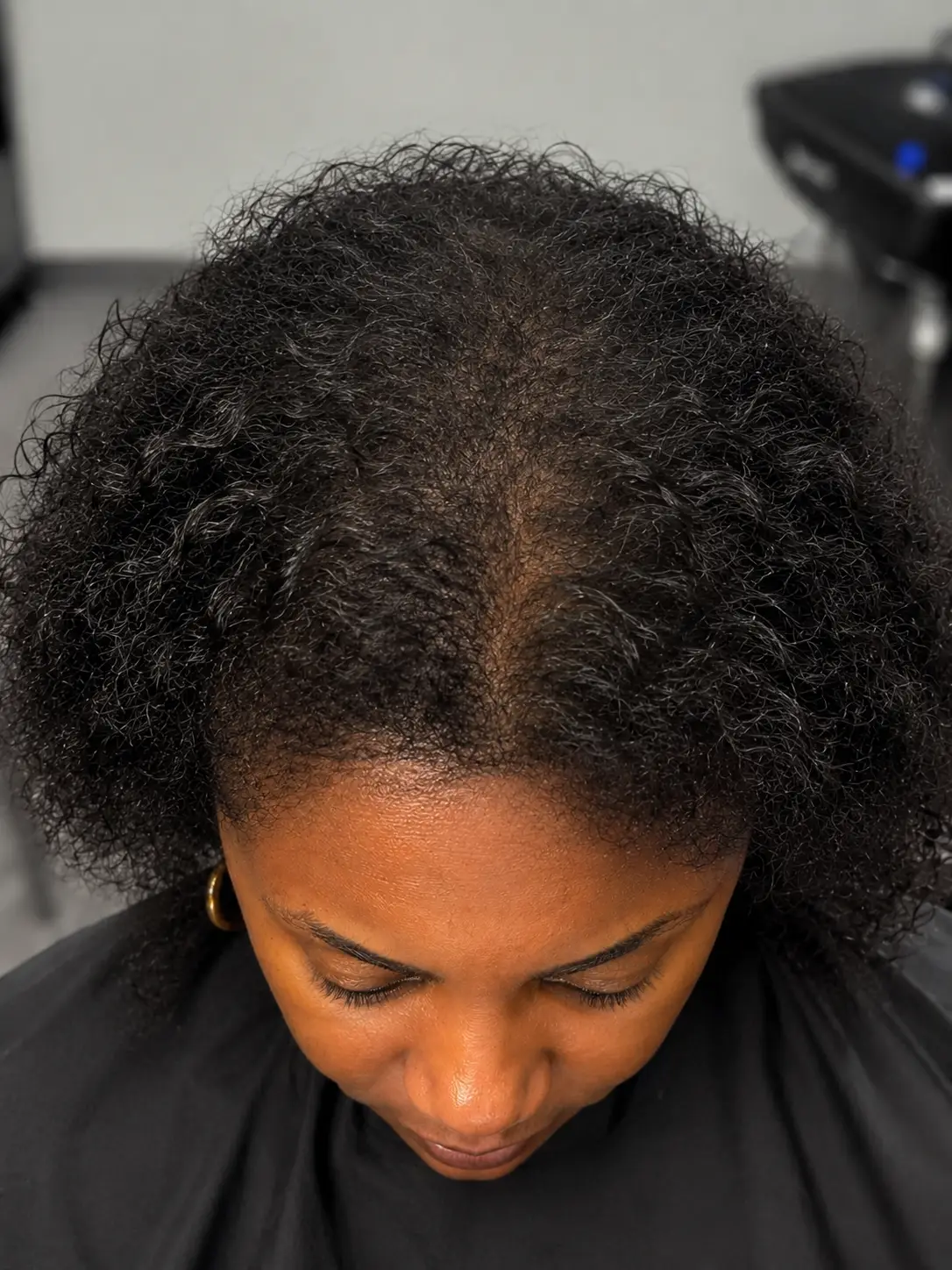
Your hair is telling you something. Let's find out what.
A 30-minute evaluation. A certified trichologist. A 200x trichoscopy scan of your scalp. And real answers before you leave the building. Your next step is $99 and one appointment away.