
Answers
How Much Hair Loss Is Normal?
The numbers behind normal shedding, and the signals that something else is happening
Losing 50 to 100 hairs per day is within the normal range. Your scalp holds roughly 100,000 follicles cycling through growth, rest, and shedding phases independently. When daily loss consistently exceeds 100 hairs or you notice visible thinning, trichoscopy can determine whether the shedding signals an underlying condition.
Losing 50 to 100 hairs per day is considered normal. The human scalp holds approximately 100,000 hair follicles, each cycling independently through three phases: anagen (active growth, 2 to 7 years), catagen (transition, 2 to 3 weeks), and telogen (rest and release, 2 to 4 months). At any given time, roughly 85 to 90% of follicles are in anagen and 10 to 15% are in telogen. The hairs you find on your pillow, in the shower drain, or on your brush are primarily telogen hairs completing their natural cycle. Shedding becomes concerning when daily counts consistently exceed 100 hairs, when you notice visible thinning or widening parts, or when the shedding pattern changes suddenly. A pull test, a gentle tug on a cluster of 40 to 60 hairs, that yields more than 6 hairs suggests active shedding beyond normal. Trichoscopy at Atlanta Trichology measures follicle density, miniaturization ratios, and anagen-to-telogen ratios to quantify whether your shedding is within range. $99 evaluation. (678) 561-4522.
The Hair Growth Cycle Explained
Anagen lasts two to seven years and determines maximum hair length. Catagen is a two to three week transition. Telogen lasts two to four months and ends with release of the hair. Because follicles cycle independently, healthy scalps shed continuously, and mild seasonal increases in autumn are normal.
Normal Shedding vs. Hair Loss
Normal looks like a steady 50 to 100 hairs a day with no visible thinning and no scalp changes. Concerning looks like a sudden jump in shedding, a widening part, more visible scalp under light, a thinner ponytail circumference, or noticeably more hair on the pillow than your baseline.
The Shower Test and Pull Test
For the shower test, collect and count the hairs in the drain across several washes and average them. For the pull test, grip 40 to 60 hairs near the root and pull gently. More than 6 released hairs suggests active shedding. Both are screening tools that flag a problem rather than diagnose it.
When Shedding Signals a Problem
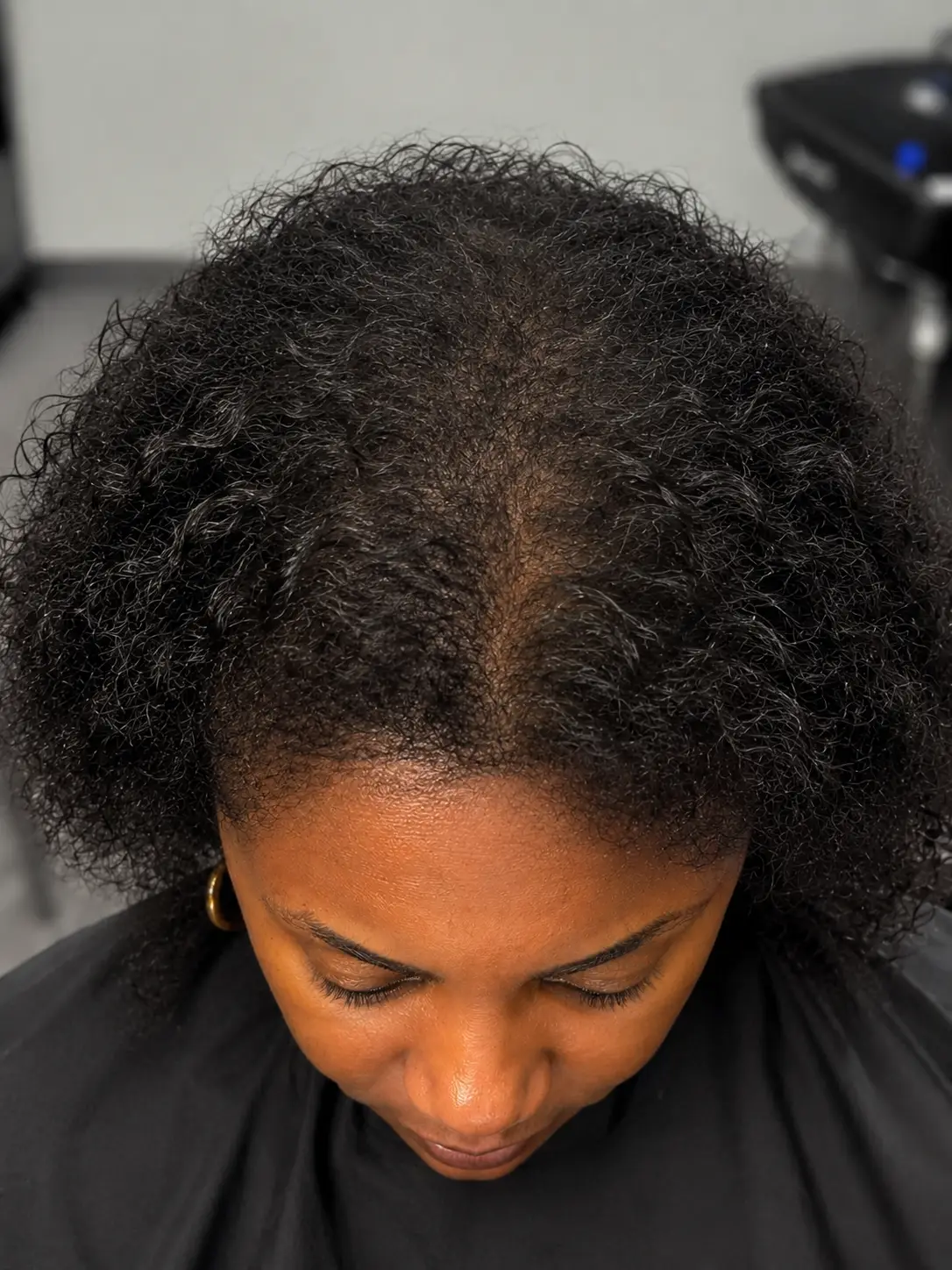
Telogen effluvium produces heavy shedding two to three months after a trigger. Androgenetic alopecia often produces normal shedding counts while thick hairs are gradually replaced by thin ones. Iron and thyroid issues drive diffuse loss. You can shed a normal amount and still be thinning, which is precisely why imaging matters.
Measuring the Invisible: What Trichoscopy Reveals
Trichoscopy quantifies follicle density per square centimeter, terminal-to-vellus ratio, miniaturization percentage, and anagen-to-telogen ratio. Those numbers detect thinning months or years before it is visible, and serial imaging tracks change across visits. At Atlanta Trichology, our certified trichologists measure all of these with 200x imaging. Dr. Nina Ross reviews the full picture. One visit, one team, one plan. The $99 evaluation captures all of it in one session.
Common Questions
Related Answers
Related Concerns
Related Treatments
Your hair is telling you something. Let's find out what.
A 30-minute evaluation. A certified trichologist. A 200x trichoscopy scan of your scalp. And real answers before you leave the building. Your next step is $99 and one appointment away.